Humanising Migration Debates via Classics
In this blog, UG student Reece Harriott reflects on what ancient literary representations of migration can offer as we try to improve the quality of debate around modern migration and enhance the empathy and humanity with which we treat refugees and asylum seekers.
June 2025
Out of all the thought-provoking topics that we have explored over the course of the module, the topic I most eagerly anticipated was migration. I am from a mixed heritage background, with both my parent’s families having migrated from the ‘Global South’ and assimilated into the Western world. So the complexities of migration and the identities that connect to it are an intrinsic part of my family’s story and of understanding myself. What I wanted to know was how Classics can help to educate and address general misconceptions and harmful social constructs that seem to be at the forefront of debate when the topic of migration is raised.
I was intrigued, but not completely surprised, that initial classroom discussion underlined the negative tone of debate that often surrounds the issue of migration, and we reflected on the intersection with racism that frequently occurs too. It was agreed that this is due in large part to the way migration is presented in the media and through political agendas, which Klaus Zimmerman highlights as societal fear.[i] Negative headlines facilitate the idea that migration creates social imbalance, causing unemployment, increased welfare spending and crime. Discussions also regularly inflate how many migrants and refugees reach the ‘global north’. For instance, the Migration Data Portal points to 304 million migrants globally (at mid-year 2024: 48% women, 13% children, 11% youth),[ii] while the UN Refugee Agency notes that ‘world-wide around 85% of all refugees live in developing regions, not in wealthy industrialised countries’:[iii]
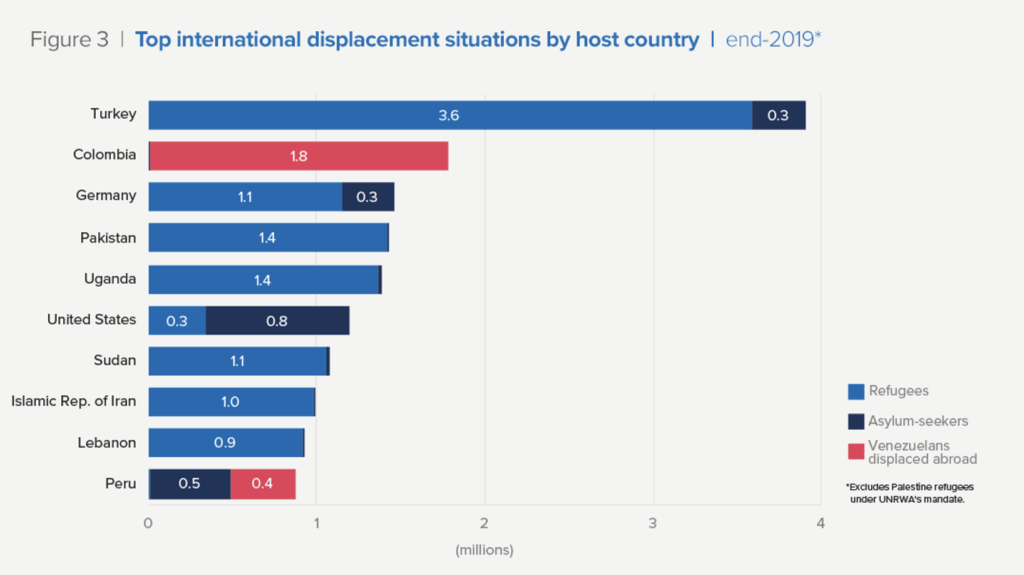
It is these features of debate – fear-mongering rhetoric, and a focus on statistics – that we must highlight and make a conscious effort to address today. Through Elena Isayev’s examination of migration in antiquity, focusing on hospitality (xenia), agency and the concept of Permanent Temporariness,[iv] I was able to consider how an Applied Classics project could provide ethical frameworks to help restore an emphasis on humanity and identity to the core of this topic.
Isayev deconstructs conceptions of hospitality in both ancient and modern societies, utilising ancient hospitality stories to expose how each society defines itself through the treatment of ‘the outsider’.[v] The Homeric ideal of xenia, the action of a host providing sanctuary or friendship to a guest, is understood to be an obligation very early in antiquity, one that presented the host as ‘civilised’ whilst also appeasing and retaining the favour of divine presences (the gods). Isayev highlights how xenia is a constant theme throughout Homer’s Odyssey, for instance.[vi] The goddess Athena acts in support of Odysseus during his travels due to the good practice of Telemachus (Odysseus’ son) in offering the goddess hospitality and sanctuary when she disguised herself as a guest; in contrast, the refusal to carry out the duties of host by the cyclops Polyphemus in Book 9 frames him as a ‘barbarian’ and ultimately leads to his downfall. Interestingly, in Book 6 the initial interaction between Odysseus and the Phaeacian princess Nausicaa is framed as a moment where the civilised, traditional procedures of supplication and hospitality become complicated. Shipwrecked by the god Poseidon onto the island of Scheria, Odysseus approaches Nausicaa and her company of ‘fair-dressed maidens’ (6.136)[vii] in his least presentable state (Figure 2[viii]). He deliberates whether to approach Nausicaa with the traditional gesture of clasping the knees, but decides ‘it seemed to him better to stand apart and beseech her with gentle words, lest the maiden’s heart should be wroth with him if he clasped her knees’ (6.147-148). This decision allows Homer to reflect a moment of self-awareness in Odysseus of the gendered, social dynamics at play, as Nausicaa, a young, unmarried woman, might have read physical supplication as an invasive act, rather than one of humility and respect. The complicated power dynamic is further affirmed by the calm and carefully measured guidance that Nausicaa provides. Although she ‘kept her place’ (6.140) and reassures her company that Odysseus is ‘some hapless wanderer’ (6.207) to whom they have obligations (they must “give to the stranger food and drink and bathe him in the river in a spot where there is shelter from the wind”; 6.209-211), Nausicaa is also abundantly aware that she must show indirect hospitality, guiding Odysseus to receive xenia from her father in the city. This reflects a tension between personal compassion and social expectation, for as much as Nausicaa desires to carry out the obligation that is expected, she is aware that being seen approaching the city with Odysseus trailing her wagon will invoke ‘ungentle speech’ (6.274) and rumour of the hero as her future husband. It is arguable that through Nausicaa, Homer presents his most inspirational host, as her response though measured is immediately ethical. Nausicaa allows Homer to present hospitality not as a rigid structure but as a contextual act, shaped by social constraints, gender and empathy. It is through her quiet act of guidance that xenia is most powerfully and authentically performed.

Isayev expands her discussion of this episode and relates it to modern migration by looking at the progression of attitudes once the obligations of hospitality moved from an individual or household responsibility to being the duty of city state at ‘the Birth of the Polis’.[ix] She particularly references this shift in her examination of Euripides’ Children of Heracles and Aeschylus’s The Suppliant Women, establishing the explicit change in Euripides’ play as being when the Chorus remarks in response to the request of hospitality ‘Is it your wish to address the city?’[x] Isayev points to the city’s newfound obligation as the host, as an opportunity for them to frame themselves as civilised and their enemies as barbaric and inhuman, even pointing to Cicero who states that ‘to debar foreigners access to the city is clearly inhuman’.[xi] This could be taken as a lesson in the modern day by the global north when the causes of migration and responsibilities of host countries gets disputed and when mobility is guarded by the ‘the anticipated privilege of passport holders’.[xii]
Isayev draws even greater attention to the nuanced agency of the suppliant, and how both the migrant worker and the refugee are bound to a state of ‘permanent temporariness’.[xiii] It is clear in both Virgil’s Aeneid and Livy’s History of Rome that Rome’s founding hero, Aeneas, could be regarded as a refugee who was given sanctuary by locals, since king Latinus allowed Aeneas – after fleeing the Trojan War – to ‘settle on nearby land once they help him overcome his enemies’.[xiv] The dynamic of this relationship – whereby Aeneas offers military muscle to king Latinus in exchange for a the right to stay – accentuates the attitude and perceived necessity of the suppliants to offer ‘acts almost as a compensation for their inability to provide reciprocal duties of xenia’[xv], a move that Isayev acknowledges feels ‘some way from the idealised unconditional xenia of the Homeric world’. Aeneas, as a ‘refugee-hero’, may have the resources to provide this utility, but it is difficult to see how many other migrants and refugees could do the same. This is why both are involuntarily in the state of ‘permanent temporariness’, as the migrant worker, who is often on low pay, works to send most ‘home as remittance’[xvi] meaning ‘their real lives and futures are still to be lived elsewhere’, and the refugee is first held in state systems such as refugee camps awaiting their asylum. It is important to underline that migrants and refugees are distinguished by a spectrum of differences when it comes to their displaced situations. However, like the dichotomy that Dina Nayeri confronts in The Ungrateful Refugee[xvii], even successful asylum-seekers – like other kinds of migrant – must still face the unfortunate reality that they will have to ‘distinguish themselves from an opportunist’,[xviii] as they face ‘de-placement’ in their host-communities.[xix]
Isayev also applies Classics in modern refugee contexts by utilising works such as Livy and Cicero for education purposes in refugee camps in Palestine.[xx] Through the ‘Campus in Camp’ initiative (Figure 3[xxi]), Isayev, along with other scholars, teach inside these camps, transforming the space from a ‘marginalised holding area to an interconnected centre of social and political life’.[xxii] Opportunities are created for refugees to reclaim agency, restoring them as active political subjects, as the university serves to break the restrictive system in place and the participants develop an ‘autonomous governance for the camp’.[xxiii] To see Classics as part of this process is an encouraging step forward for our discipline, as Isayev utilises the Classical canon to prompt discussion and restore both humanity and agency to the centre of migration experiences.

Isayev’s work has allowed me to consider how my Applied Classics project (a well-being journal) might intersect with this theme. Designed with a section that draws on ancient texts to discuss the topic of identity, it has the potential to act as a place where emotional reflections and self-understanding of complex identities can be safely held. The journal can therefore be a space of symbolic hospitality and a sanctuary of self-expression for those navigating feelings of displacement. For example, a new section called ‘Voices of Displacement’ could be added, directly inspired by bottom-up approaches that amplify refugee voices, including them in tandem with relatable voices from the ancient world, such as those in Aeschylus’ The Suppliant Women. The journal could even outline the “Campus in Camps” initiative in one of the interactive sections, to prompt the reader to creatively map out and draw their own ‘campus’ or space of belonging. This may help them deconstruct and find alternative and personal ways to tackle the complex structure of identity.
[i] Zimmerman, Klaus. “Migration: Challenges and Perspectives | Lecture”, October 2020 https://www.youtube.com/watch?v=s7vGDwXKoh8
[ii] “Migration and Human Mobility Key Global Figures” Migration and Human Mobility: Key Figures
[iii] “UNHCR Global Trends 2019” UNHCR Global Trends 2019 | UNHCR
[iv] Isayev, Elena. 2021. “Ancient Wandering and Permanent Temporariness.” Humanities 10: 91. https://doi.org/10.3390/h10030091
[v] Isayev, Elena. “Hospitality: A Timeless Measure of Who We Are?”, Migration and Society 1, 1 (2018): 7-21, https://doi.org/10.3167/arms.2018.010103
[vi] Isayev, Elena. “Between Hospitality and Asylum: A Historical Perspective on Displaced Agency.” International Review of the Red Cross 99, no. 904 (2017): 75–98. https://doi.org/10.1017/S1816383117000510.
[vii] Homer. “The Odyssey with an English Translation by A.T. Murray, PH.D. in two volumes.” Cambridge, MA., Harvard University Press; London, William Heinemann, Ltd. 1919. http://data.perseus.org/citations/urn:cts:greekLit:tlg0012.tlg002.perseus-eng1:6.127-6.161
[viii] Desubleo, Michele. “Odysseus and Nausicaa” Oil on canvas, 17th century. Accessed via Maicar.com. https://www.maicar.com/GML/Nausicaa.html
[ix] Isayev, Elena. “Hospitality: A Timeless Measure of Who We Are?”, Migration and Society 1, 1 (2018): 7-21, https://doi.org/10.3167/arms.2018.010103
[x] Ibid.
[xii] Ibid.
[xiii] Isayev, Elena. 2021. “Ancient Wandering and Permanent Temporariness.” Humanities 10: 91. https://doi.org/10.3390/h10030091
[xiv] Isayev, Elena. “Between Hospitality and Asylum: A Historical Perspective on Displaced Agency.” International Review of the Red Cross 99, no. 904 (2017): 75–98. https://doi.org/10.1017/S1816383117000510.
[xv] Ibid.
[xvi] Isayev, Elena. 2021. “Ancient Wandering and Permanent Temporariness.” Humanities 10: 91. https://doi.org/10.3390/h10030091
[xvii] Nayeri, Dina. The Ungrateful Refugee: What Immigrants Never Tell You. New York: Catapult, 2019.
[xviii] Estevez Yanes, Maria Jennifer. 2024. “Seeking Refuge, Resisting beyond Borders: On Security, Recognition and Rights in Dina Nayeri’s Refuge and The Ungrateful Refugee” Humanities 13, no. 1: 35. https://doi.org/10.3390/h13010035
[xix] Isayev, Elena. 2021. “Ancient Wandering and Permanent Temporariness.” Humanities 10: 91. https://doi.org/10.3390/h10030091
[xx] “Campus in Camps – A University in Exile”, June 2013 Campus in Camps » about
[xxi] Campus in Camps. “Outdoor Learning Session, Dheisheh Refugee Camp” Photograph. c. 2012. Accessed from Campus in Camps » about
[xxii] “Campus in Camps – A University in Exile”, June 2013 Campus in Camps » about
[xxiii] Ibid.